AI can post a transaction. It can’t protect your business.
Business owners are asking legitimate questions.
Will accountants be replaced by AI? Will AI take over accounting? As accounting AI software becomes more capable, some founders wonder whether accounting itself is becoming fully automated.
The answer is more nuanced than most headlines suggest.
AI is already changing accounting. Modern tools can categorize transactions, process invoices, reconcile accounts, and accelerate month-end close. Much of the manual work that once consumed accounting teams can now happen automatically.

Accounting has never simply been about recording transactions. It’s about understanding what the numbers mean, identifying risk, and helping businesses make decisions.
That’s the part the software doesn’t do.
Every accounting tool on the market right now is selling the same promise: faster books. Auto-categorized transactions. Receipts that reconcile themselves. A close that takes days instead of weeks.
A lot of that promise is real. The software has gotten good. If your only goal is to get numbers into buckets quickly, you have more options than ever, and they all cost less than a part-time hire.
But speed isn’t the hardest part of finance. Judgment is. And that’s the part the tools quietly leave out of the pitch.
Two Layers of Finance
Think about your finance function in two layers.
The bottom layer is mechanical:
- It records what happened
- Matches receipts to charges
- Reconciles the bank feed
- Closes the books
The top layer is where finance moves from recording activity to interpretation:
- Should this be capitalized or expensed?
- Is this revenue recognizable yet?
- Does this spending pattern mean we have twelve months of runway or six?
- Will this accounting treatment hold up during diligence?
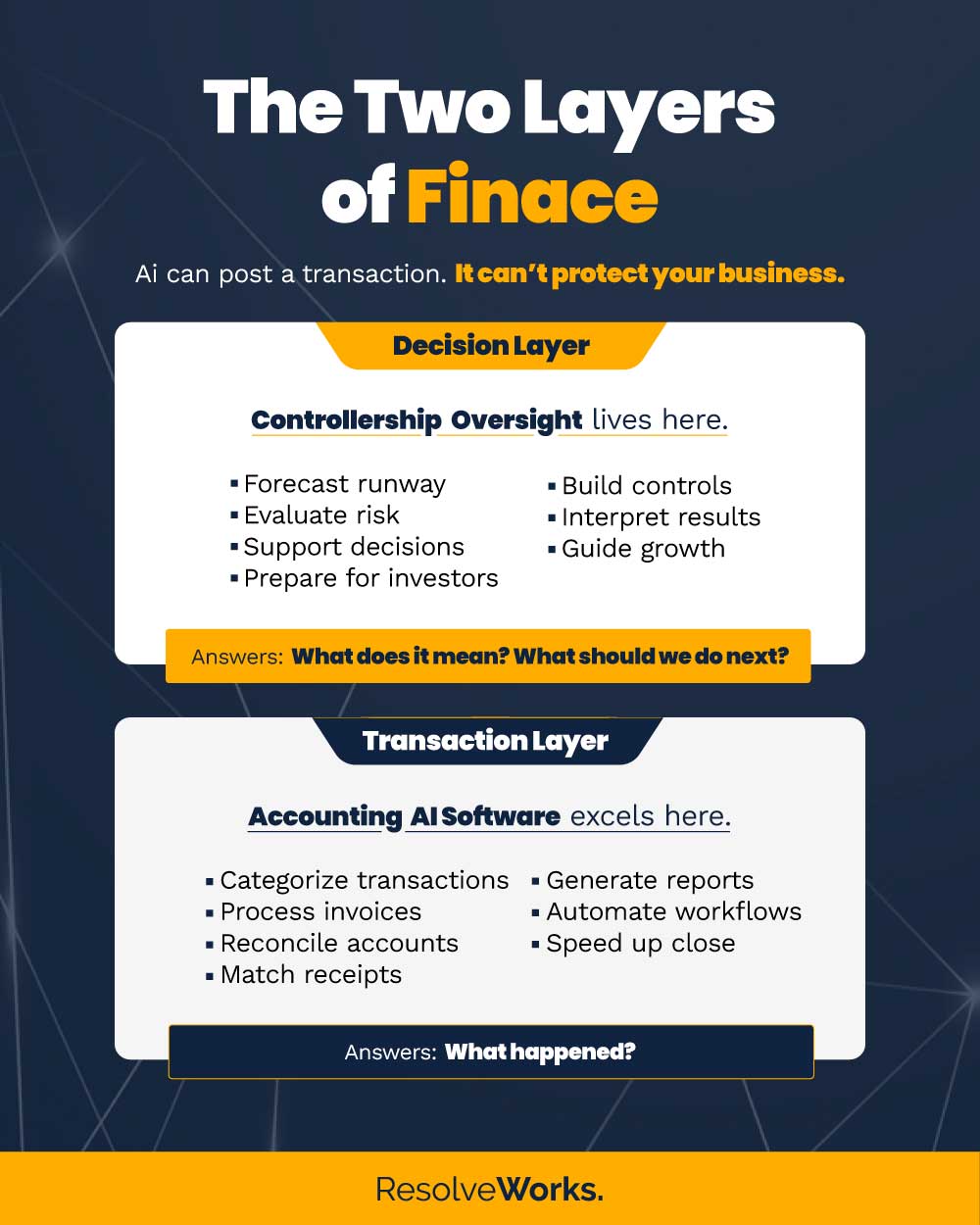
The bottom layer answers what happened. The top layer answers what does it mean, and what should we do next?
This distinction becomes easier to see when you separate what accounting AI software is designed to do from the responsibilities that still require financial oversight.
AI lives primarily in the transaction layer. It’s getting very good there. It does not operate in the decision layer, and the companies selling accounting AI software know that, which is why the marketing almost always stops at “faster.”
The danger isn’t that the tools are bad. It’s that a fast, clean-looking transaction layer makes it easy to believe you don’t need the decision layer at all. The books look done. The dashboard is green. Everything reconciles.
So why pay for controllership services? Because reconciled isn’t the same as right. That’s the difference between books that balance and books you can actually make decisions on.
How Accounting AI Software Processes Transactions
When AI posts a transaction, it’s doing pattern matching. It sees a charge from a vendor it recognizes, looks at how similar charges were handled before, and drops it into the most likely category. It’s fast, it’s cheap, and oftentimes it’s right.
But here’s the thing: “Most of the time it’s right” is a great standard for sorting email. It’s a terrible standard for the financial record your investors, your board, and eventually a buyer or an auditor are going to rely on.
The transaction that gets miscategorized doesn’t announce itself. It just sits there, quietly wrong, until the moment it matters.
A software subscription booked as a utility expense. A customer prepayment recognized as revenue before you’ve earned it. A founder’s personal card charge that should never have touched the books at all.
The tool posted all three confidently. None of them got a second look.
That second look is an important part of the job. And no tool on the market does it, because doing it isn’t a posting problem. It’s a judgment problem.
Faster Books, Same Bad Decisions
Here’s the trap we see founders fall into. They automate the bookkeeping, the close gets faster, and they feel like they’ve solved the finance function.
Then a decision comes up that the numbers were supposed to inform. A hiring plan. A pricing change. A board request. A fundraise. And the numbers don’t actually answer the question.
They’re current. They’re tidy. But nobody has asked whether they’re structured in a way that supports the decision sitting in front of you.
Faster books just means you may arrive at a bad decision sooner.
Speed without judgment doesn’t reduce risk. It compounds it, because now you’re moving quickly on a foundation nobody has stress-tested.
The most expensive finance mistakes we clean up usually don’t come from slow bookkeeping. They come from confident, fast, automated bookkeeping that nobody with experience reviewed.
What Financial Oversight Provides
When we talk about controllership, this is what we mean. It’s not simply recording transactions. It’s providing the financial oversight that helps businesses make better decisions, reduce risk, and move forward with confidence.
As companies grow, the numbers begin to carry more weight. Investors rely on them. Boards ask questions about them. Hiring decisions, fundraising conversations, and growth plans all depend on them.
Financial oversight helps ensure those numbers are accurate, reliable, and useful. In practice, that means:
- Identifying issues that may be technically posted but materially incorrect before they affect reporting, taxes, or due diligence.
- Building controls so the same mistakes don’t continue quietly in the background month after month.
- Structuring financial information around the decisions you’re actually going to make instead of simply filing transactions into generic categories.
- Standing behind the numbers when investors, board members, lenders, or auditors begin asking important questions.
This is the work that gives founders confidence in the numbers they’re using to run the business.
A controller doesn’t simply close the books. They help management understand what the numbers mean, identify potential risks, and prepare for the decisions ahead. They notice when assumptions no longer match reality. They identify trends that affect cash flow and runway. They help leadership teams understand the financial impact of major decisions before those decisions are made.
That’s the value of financial oversight.
Will AI Take Over Accounting?
In some ways, it already has. Routine bookkeeping tasks are becoming increasingly automated. Transaction processing, reconciliations, coding expenses, and portions of the close process can now happen faster and more efficiently than ever before.
Will accounting be replaced by AI entirely? No. The larger the decisions become, the more valuable financial judgment becomes.
Investors still ask questions. Boards still challenge assumptions. Auditors still require explanations. Founders still need someone to tell them whether they have six months of runway or twelve.
The future of accounting isn’t AI versus accountants. It’s automation handling the mechanical work while experienced finance professionals provide oversight, accountability, and guidance.
Let the software post the transaction. Let someone protect the business.
Resolve Works gives venture-backed founders a full finance team, not a single hire, scaled to wherever you are right now. No key-person risk. Investor-ready from day one.
If your books are fast and clean but you’re not sure they’d hold up under real scrutiny, that’s worth a conversation.